
How to Price Building Work in the UK: A 7-Step Method for Builders (With £ Examples)
Most builders price by feel: a day rate, a rough £ per m², “what the last job cost”. Some jobs make money, some lose it — and nobody knows which until the bank account says so. This is the method we use to price jobs from £10K to £2M+.
- How to build your own rates library from real jobs
- Pricing by packages like a main contractor — with your margin on each
- The prelims builders forget, and how to add overheads properly
- Allowances, provisional sums and a quote layout that wins
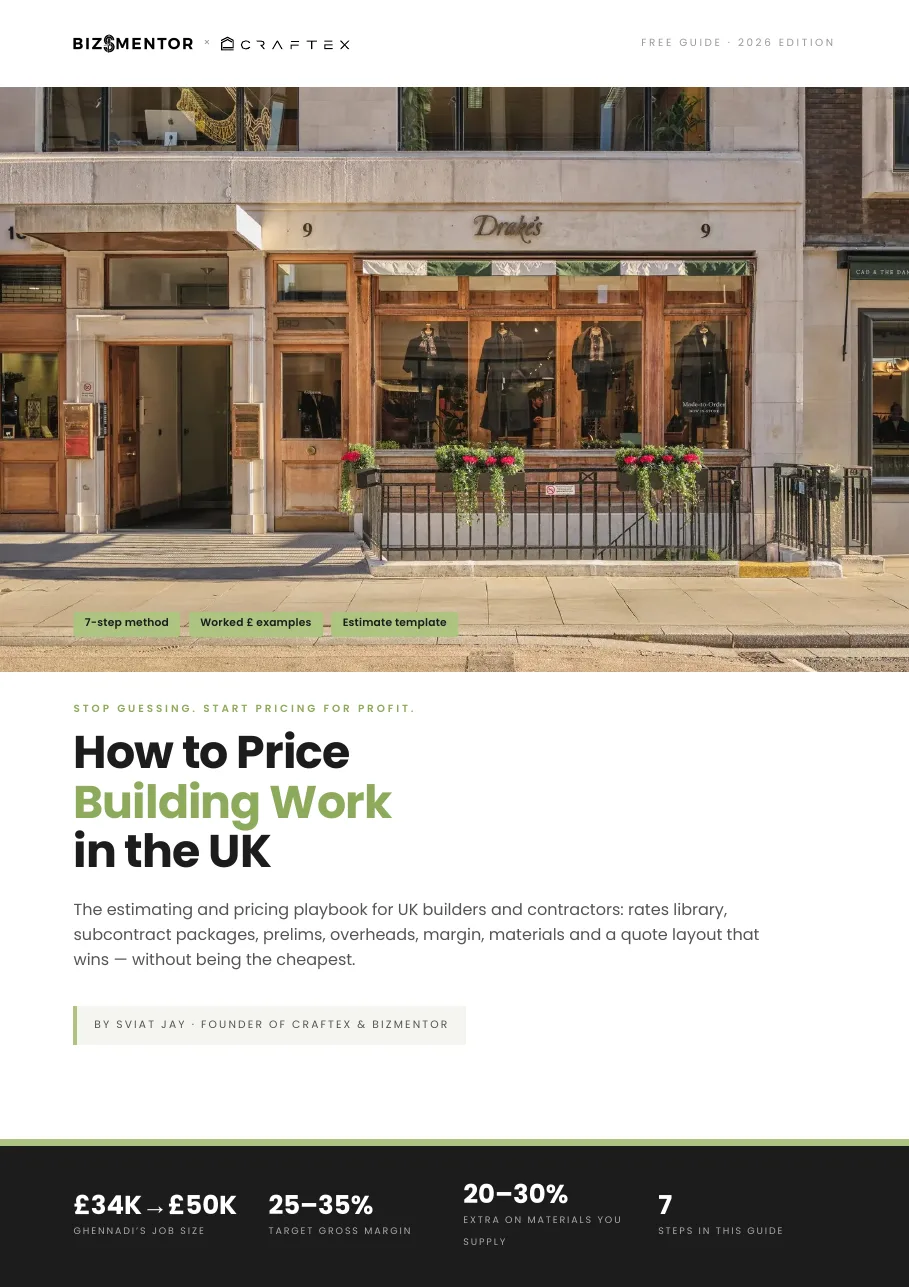
Get the free PDF guide
13 pages. Sent to your inbox in 2 minutes.
The short answer
To price building work properly:
- Build a rates library from your own finished jobs.
- Break the job into packages and get two or three subcontractor prices for each one you don’t cover.
- Price the prelims — skips, protection, scaffold, welfare, parking, supervision.
- Add overheads and a target margin using price = cost ÷ (1 − margin).
- Supply materials yourself and use allowances for items the client chooses.
- Write a structured quote with exclusions, programme, payment schedule and options.
- Price to win without being the cheapest — change scope, not margin.
Priced too low, you work for free. Priced by guesswork, you never know.
Pricing is where most builders leave the most money on the table — and the fastest place to find more profit. You keep more from the work you already win. Ghennadi, a decorator from Northampton, went from £2K to £13.5K a month profit in 60 days, largely by pricing jobs properly and presenting quotes live.
Build your own rates library
Start a spreadsheet: item, unit (m², m, nr, day), labour time, labour cost, material cost and total rate. Fill it from your own finished jobs — how long did 40 m² of plasterboard really take? Record every subcontractor price you receive. Update it after every job and in six months you’ll price in half the time.
Step 2Price by packages, like a main contractor
Break the project into packages — strip-out, structure, electrics, plumbing, plastering, joinery, flooring, decoration — and price each one separately. Price your own trades from the library, get two or three subcontractor quotes for the rest with the same scope, and add your management margin on every package. An unusually cheap sub quote usually means something is missing.
Price the prelims you’re forgetting
Prelims are the costs of running the site rather than building anything: skips and waste, floor and wall protection, welfare, scaffolding and towers, parking permits and congestion charge, cleaning, supervision, surveys and building control, plant hire, deliveries and travel. On a three-month job they can wipe out the whole profit. Price them as their own line.
Get the estimate summary sheet
The free playbook includes a package-by-package estimate sheet and a before-you-send quote checklist.
Add overheads and margin — properly
| Example: £80K extension | |
|---|---|
| Direct costs: labour, packages, materials, prelims | £56,000 |
| Target gross margin | 30% |
| Price = £56,000 ÷ (1 − 0.30) | £80,000 |
| Gross profit | £24,000 |
| Overheads (12% of price) | −£9,600 |
| Net profit (18%) | £14,400 |
Use margin, not markup: a 25% markup is only a 20% margin. Small jobs need a higher margin percentage. And never price your own wage as profit — it’s a cost.
Step 5Supply the materials — and use allowances
Letting the client buy materials feels cheaper for them, but you lose margin, control of the programme and the right to blame late deliveries. Supply them yourself and add a margin — often 20–30% more on that part of the job. For client-chosen items put an allowance in the quote (“tiles: £35/m² supply allowance”); anything above it is a variation. Use provisional sums for work you can’t measure yet, and sign every variation before you do it.
Write a quote that wins
Two builders, same price: the clearer quote wins. Include a summary of their goals, packages priced separately, allowances and provisional sums, inclusions and exclusions, programme, options, a payment schedule with stages due in advance, proof (similar projects, insurance, reviews) and a validity date. Then present it live — never just email it.
Step 7Price to win without being the cheapest
- Ask how many builders are quoting and what matters most before you price.
- On competitive tenders, show a lean base price and offer upgrades as options.
- If you lose on price, ask for the winning quote and compare line by line.
- Sell on time and certainty: “6–8 weeks, not 3–5 months.”
- Cut scope to hit a budget, never your margin.
Get the full Pricing Playbook
The 7-step method with £ examples, a pricing score and worksheets. 13 pages, free.
Builders who fixed their pricing
Real clients, real numbers. Every story is on YouTube.
“At the beginning, he showed me the basics — how to find the right jobs, price and estimate projects, find clients and get the first money coming in.”
Planex Ltd · Trustpilot“After just a month and a half, I had earned back everything I'd invested and even made a profit on top.”
Sergey Dimov · TrustpilotIndividual results, not typical or guaranteed. Outcomes depend on your business, market and effort.
Frequently asked questions
How do builders price a job in the UK?
Professionally: by measuring the work, pricing each package from a rates library and subcontractor quotes, adding prelims and contingency, then adding overheads and a target margin. Day rates and £/m² guesses are fine for a sense check, not for the final price.
What margin should a builder add?
On main-contractor work we aim for 25–35% gross margin and around 10%+ net after overheads. Remember markup and margin differ: a 43% markup gives roughly a 30% margin.
Should I let clients supply their own materials?
Usually no. Supplying materials yourself protects your programme and margin. For items the client wants to choose, use an allowance in the quote and treat anything above it as a variation.
What are prelims in a building quote?
The costs of running the site: skips, protection, welfare, scaffolding, parking, cleaning, supervision, surveys and plant. Price them as their own line so they’re never forgotten.
How do I stop losing jobs to cheaper builders?
Qualify first, show a lean base price with options, compare competitor quotes line by line, and sell on programme and certainty. Change the scope to meet a budget rather than cutting your margin.
Keep going
Get the full Builder’s Pricing Playbook
- Your pricing score in 5 minutes
- Rates library and estimate summary templates
- Quote layout that wins without being the cheapest
From Sviat Jay, founder of Craftex (150+ projects across London) and BizMentor.
Send me the free guide
Free. No spam. Unsubscribe anytime.