How to Complete a Construction PQQ or Selection Questionnaire


The short answer
A PQQ checks you are allowed and able to do the job before anyone reads your price. Pass it with a ready pack: accounts, insurances, health and safety, quality and three case studies with references.
- It's a gate, not a beauty contest. Most questions are pass/fail. Miss one document and your price is never opened.
- Public work has changed. Since 24 February 2025 public buyers use the Procurement Specific Questionnaire (PSQ), fed by the Central Digital Platform. Private clients still send PQQs.
- Size and evidence win. Buyers check turnover against contract value, then score three similar contracts with references who answer the phone.
- Build the pack once. Update it every quarter and every PQQ takes hours, not days.
The construction PQQ arrives, 40 pages long, asking for policies you've never written and accounts you haven't filed yet. Most small contractors either give up or rush it the night before. Either way, the price they spent a week on never gets read.
Pre-qualification is a gate, not a contest. Treat it as admin you do once, properly, and it stops being the reason you lose. Here's how to complete it, section by section. If you want someone to check your pack, book a free strategy call.
PQQ, SQ, PSQ: what you'll actually be sent
The names changed over the years, but the job is the same. Prove you're allowed and able to do the work before you're invited to price.
| Form | Who sends it | What to know |
|---|---|---|
| PQQ (pre-qualification questionnaire) | Main contractors, developers, housing associations, private clients via a QS | Each one is different; many follow the Common Assessment Standard |
| SQ (selection questionnaire) | Public buyers before February 2025 | You'll still see it on older frameworks and some private forms |
| PSQ (Procurement Specific Questionnaire) | Public buyers under the Procurement Act 2023, from 24 February 2025 | Your core details come from your Central Digital Platform record |
| Common Assessment Standard certificate | CHAS, Constructionline or Achilles | One assessment that many buyers accept in place of their own questions |
For public work in England, register your company on the Central Digital Platform (through Find a Tender) before you need it. Your core supplier information sits there and feeds every PSQ, so you don't type it out each time.
How to complete each section of a construction PQQ
Most questionnaires follow the same order. Work through them like this.
Company details
Legal name, Companies House number, registered address, VAT and CIS details, directors, any parent company. On a PSQ this is your core supplier information.
Check: it matches Companies House exactly. A different trading name or old address creates questions you don't need.
Exclusion grounds
Declarations about convictions, unpaid tax, insolvency, professional misconduct and serious breaches of past contracts, for your company and connected people such as directors.
Check: answer honestly. If something applies, explain what happened and what you've changed since. A hidden issue found later is far worse than a declared one with evidence of self-cleaning.
Financial standing
Usually your last two years of accounts, sometimes a turnover threshold or ratio tests. Buyers check that one contract won't be most of your yearly turnover.
Check: if your accounts are late or show a loss, add a short note explaining why and attach recent management accounts or a bank reference. Then be honest with yourself about whether the contract fits your size.

Insurance
Employer's liability (a legal requirement if you employ people), public liability and, where you do design, professional indemnity. Questionnaires state the minimum cover they want.
Check: if your cover is below the level asked, say you'll increase it on award and get a quote first. Many buyers accept that.
Health and safety
A written health and safety policy, required by law once you have five or more employees. Risk assessment and method statement examples, training records, and accident and RIDDOR history. How you manage subcontractors and CDM duties.
Check: a Common Assessment Standard certificate often answers this whole section. Without one, attach real documents, not a downloaded template with someone else's company name still in it.
Quality and environment
How you check work, handle defects, manage waste and reduce environmental impact. Larger buyers may ask for ISO 9001 or ISO 14001.
Check: a two-page quality procedure you actually follow beats a 40-page manual nobody has read. See ISO 9001 for construction companies for when certification is worth it.
Technical ability and experience
The scored part. Usually three contracts of a similar type and value from the last few years, with client, value, dates, scope and a referee.
Check: match the work. A buyer tendering a school refurbishment wants education or occupied-building work, not three loft conversions. Tell your referees to expect the call.
Policies and social value
Equality, modern slavery, data protection, sometimes social value. A modern slavery statement is only a legal requirement at £36M+ turnover, but short policies on each are expected.
Check: keep them short, honest and signed by a director.
Not sure if your accounts or turnover will pass?
Book a free call and we'll look at it with you.
The pack: build it once
Keep one folder, named and dated, with a review every quarter:

- Company documents, VAT and CIS details, Central Digital Platform login
- Last two years of accounts plus recent management accounts
- Insurance certificates with expiry dates in your calendar
- Health and safety policy, RAMS examples, training matrix, accident record
- Quality, environmental, equality, modern slavery and data protection policies
- Case studies by sector, each with value, dates, photos and a referee
Craftex, Sviat's London design and build company, holds CHAS, SafeContractor and ISO 9001, 14001 and 45001, so we know what buyers check. But we didn't need all of that to start.
I made this mistake myself. At Craftex I paid a lot for accreditations, and on their own they never paid off. Get an accreditation only when a specific tender for a specific project asks for that specific accreditation. Most schemes take 2–3 months, so you will have time once the request is real. Don't buy them hoping work will start pouring in. It won't.
The mistakes that knock contractors out
| Mistake | What happens | Fix |
|---|---|---|
| A pass/fail question left blank | Automatic fail, price never opened | Answer every question, even with "not applicable, because…" |
| Out-of-date insurance certificate | Fail or a clarification you might miss | Calendar reminders a month before every expiry |
| Case studies that don't match | Low score on the only scored section | Group case studies by sector and value |
| Template policies with another firm's name | Instant loss of credibility | Write short policies in your own words |
| Contract too big for your turnover | Fail on financial standing | Bid on work that fits; grow through smaller contracts first |
| Missed the clarification deadline | You answer on assumptions | Read the instructions first and note every date |
Losing tenders regularly, not just at pre-qualification? Read why contractors keep losing tenders to find the stage where your bids fail.
What happens after you pass
Passing gets you invited to tender, or onto a framework or approved list. Then the real competition starts: price, programme and the quality answers. That's where a properly written method statement for the tender earns its marks.
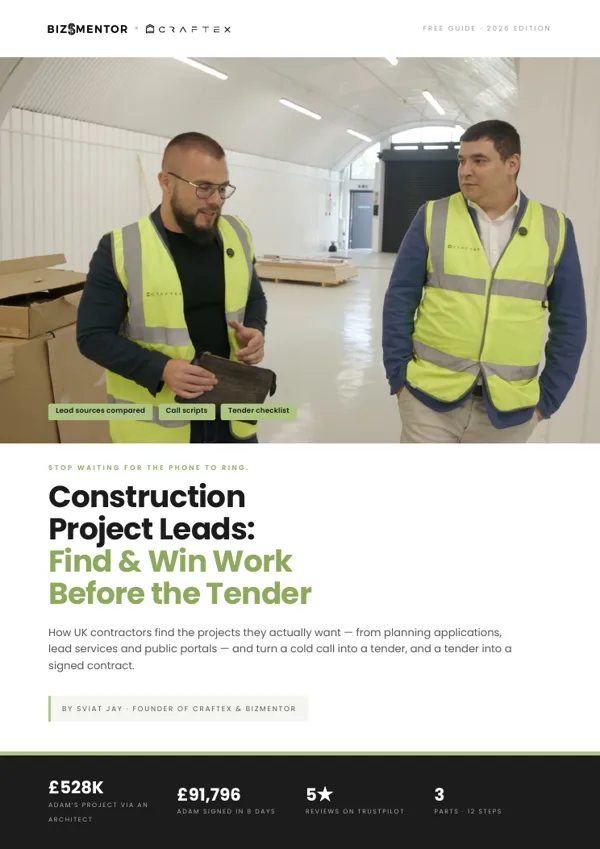
Construction Project Leads Guide
Where contractors find projects before they're tendered, plus the 10 moves that win at tender stage.
Get the free guideWould you rather have contractors handle the pack, the questionnaire and the bid with you? Our bid writing and tender service does exactly that. Our accreditation service sorts CHAS, Constructionline or ISO when a buyer asks for it.
Want to grow into tendered work as part of a bigger plan? BizMentor's one-to-one mentoring with Sviat, who runs a working construction company, covers the whole route. BizMentor mentoring aims for results in about 4 months rather than 1–3-year programs. Start with the free 4-minute Construction Business Scorecard.
Want to know which tenders you could pass today? Book a free strategy call.
This is general information from a contractor's experience, not legal advice. For the bigger picture, read how to win construction tenders in the UK.
Before you open the next questionnaire
- Registered on the Central Digital Platform for public work
- Accounts, insurances and policies in one dated folder
- Three case studies for each sector you bid in, with referees warned
- Every pass/fail question answered, nothing left blank
- The contract value checked against your turnover before you start