Material Prices Went Up After You Quoted? What You Can Charge

The short answer
Your paperwork decides it. An accepted fixed price usually means the rise is yours, unless the quote had expired, carried a price adjustment clause or used provisional sums. Re-cost today, talk to the client once with the supplier's numbers, and change your quote wording before the next job.
- What you signed decides it, not the supplier. Accepted fixed price = the rise is normally your risk. Expired quote, adjustment clause or provisional sum = you have a basis to ask.
- Prices really are moving. The official UK material price index for all work rose 6.4% in the year to August 2026. Fabricated structural steel rose 21.2% and rigid pipes and fittings 15.5%.
- Re-cost today, then have one honest conversation. Get new prices in writing, lock the big items, and show the client the old and new supplier prices with options.
- Homeowners have extra protection. A price rise clause without a right to cancel can be unfair under the Consumer Rights Act 2015, so fix your next quote's wording.
You priced the extension in spring. The client signed in summer. Now the merchant's new price list is in your inbox. Steel, copper pipe and insulation are all up. Your margin on the job has shrunk by a third before you've started.
Most of what Google shows for this is old news about price rises. This guide is for the builder whose material prices went up after they quoted. Can you charge the client more, and how do you ask without losing the job? To work it through with our team, book a free strategy call.
This is general information from a contractor's experience, not legal or financial advice. For your situation, speak to a solicitor or accountant.
First 24 hours: find out what you actually agreed
Before you ring anyone, get the quote, the client's acceptance (email, WhatsApp, signed contract) and any terms you sent. What those documents say decides whether you can pass the rise on.

| What your paperwork says | Can you pass the rise on? | What to do now |
|---|---|---|
| Fixed price, accepted, no validity date and no adjustment clause | Usually no. The market moving is normally your risk | Re-cost, cut cost elsewhere, ask for goodwill only |
| Client accepted after your quote's validity date had passed | You have a basis to re-confirm the price before you start | Write and confirm the current price before ordering |
| Quote said prices were based on supplier prices on a stated date, with a written adjustment clause | Yes, as the clause allows, with evidence | Send the supplier's old and new prices |
| The item was a provisional sum or a prime cost allowance | Yes. The actual cost replaces the allowance | Send the invoice and the adjustment |
| Client changed the spec or added work | Yes. It's a variation priced at today's cost | Price it in writing before you do it |
| JCT contract | Only under the fluctuations option chosen in the contract particulars | Check which option was selected |
| No price was agreed at all | The law implies a reasonable price | Price fairly and show your costs |
If you're on the first row, the money is not in arguing about the price. It's in the steps below: the exact gap, locking prices, and an honest request.
Work out what went up after you quoted, item by item
"Prices have gone up" loses the conversation. A table with the supplier's old and new figures wins it. Ask each supplier for the new price in writing today.
| Item | Quoted → now | Extra |
|---|---|---|
| Steel beam | £1,850 → £2,240 | £390 |
| Copper pipe | £1,200 → £1,390 | £190 |
| Insulation | £1,600 → £1,780 | £180 |
| Other | £11,100 → £11,300 | £200 |
| Total | £15,750 → £16,710 | £960 |
Example figures for a £45,000 extension at 20% margin (£9,000). A £960 rise is about 2% of the price, but it takes more than 10% of your profit. Show the client the first number and keep the second for yourself.
The official figures back you up. The UK material price index for all work rose 6.4% in the year to August 2026. Fabricated structural steel rose 21.2%, rigid pipes and fittings 15.5% and steel reinforcing bars 12.5%. Some things fell slightly: cement, ready-mixed concrete and imported timber.
Problems like this usually trace back to cash and contracts. Take the free 4-minute Construction Business Scorecard: 18 questions on your pipeline, sales, pricing, cash flow and systems, with your weakest area shown first. Want someone to run valuations, variations and final accounts for you? See our commercial management service.
Lock prices before they move again
Every week you wait can make the gap bigger. Do this before the client conversation, not after.
- Order or deposit the big items now. Steel, windows, kitchens and anything on a long lead time. Ask the merchant to hold the price in writing against a deposit.
- Get two more prices for the items that rose most. Same specification only.
- Don't swap specifications quietly. A cheaper product that differs from the drawings or the quote is a breach, and structural or thermal changes can affect building regulations approval. Any swap needs the client's agreement, and the designer's or engineer's where relevant.
- Check your own waste and ordering. Over-ordering by 10% on a material that rose 15% costs you twice.

Stopping work, or refusing to start, until the client agrees to pay more. On a fixed-price job that usually puts you in breach, and the client can claim the cost of another builder finishing. Ask, don't hold the job hostage.
Telling the client: the call and the letter
Call first, so they hear it from you with a reason. Then send the same thing in writing the same day. Give options, not an ultimatum.
"Hi [name], I want to be upfront about something before we order materials for your job. Since we priced it in [month], our suppliers have raised several prices. Steel alone has gone up by [£x]. I've put the old and new prices side by side so you can see exactly what's changed. [If your quote allows it: Our quote said prices were based on supplier prices on [date], so I'm asking to adjust by £[x].] [If it doesn't: Our price is fixed and we'll honour it. I'm asking whether you'd be willing to share part of the increase.] There are three ways we can handle it, and I'm happy to go with whichever suits you."
The letter (copy and adapt):
Subject: Material prices for [job address]: options before we order
Dear [name],
Thank you for confirming the work at [address]. Before we place orders, I want to tell you about price rises from our suppliers since our quote of [date].
The attached table shows the affected items, with the supplier's price at the time of our quote and their price today. The total increase is £[x].
[Clause applies:] Under [clause/paragraph] of our quote, prices were based on supplier prices on [date] and may be adjusted with evidence. We are asking to adjust the price by £[x], to £[new total]. If you would prefer not to go ahead at the adjusted price, please tell us by [date].
[Fixed price:] Our price is fixed and we will honour it. We would be grateful if you would consider one of these options:
- Share the increase: you pay £[half], we absorb the rest.
- Change the specification: [item] to [alternative], which keeps the price at £[original]. [Subject to the designer's approval.]
- Order now: you pay a materials deposit of £[x] so we can buy before further rises, deducted from your next stage payment.
Please let me know which you prefer by [date], in writing. We will not order the affected items until we hear from you.
Kind regards, [name, company, phone]
Whatever they choose, confirm it in writing before you order. A "yes" on a phone call is hard to prove at the final account.
Prices just jumped on a job you've already quoted?
Book a free call and we'll work through the numbers and the conversation with you.
Homeowner or business client: what changes
The rules are stricter when your client is a consumer, which includes homeowners having work done on their own home.
- What you told them is part of the deal. Anything you said or wrote about the job or the price that they relied on is treated as a term of the contract.
- Open-ended price increase terms can be unfair. The Consumer Rights Act 2015 lists one term that may be unfair. It lets a trader increase the price without giving the consumer the right to cancel. That matters if the final price is too high compared with the price agreed. A fair clause says what can change, how it's measured and lets the client walk away.
- No price agreed means a reasonable price. For consumers and businesses alike, if no price was fixed and no method was agreed, the law implies a reasonable price.
With a business client (a developer, a main contractor, a company), you have more freedom to agree price adjustment terms. They still have to be in the contract before it's signed.
JCT and other standard contracts
If you signed a JCT contract, look at the fluctuations section of the contract particulars before you write a word to the client.
| JCT fluctuations option | What it covers |
|---|---|
| Option A (the default in the larger JCT forms) | Changes in contributions, levies and taxes only. Not material price rises |
| Option B | Changes in the cost of labour and materials, plus taxes |
| Option C | A formula adjustment using published price indices |
JCT's Minor Works contract only carries Option A-type provisions. For the 2024 editions JCT publishes the options free on its website. If nothing was selected, assume your price is fixed for materials. Our guide to JCT contracts for UK builders explains how the forms fit together.
Next quote: the wording that protects you
The job you're on is mostly a negotiation. The next one is a choice. This is the wording we recommend on every quote.
- Validity: "This quote is valid for 30 days from [date]." Shorter for steel, copper and anything volatile.
- Price basis: "Prices are based on supplier prices at the date of this quote."
- Provisional sums for items you can't price firmly yet (kitchens, sanitaryware, client-chosen finishes), with the allowance shown.
- A fair adjustment clause: what can change, the evidence you'll provide, a cap, and the client's right to cancel if the rise is more than an agreed amount.
- Stage orders: big items ordered and paid for as a stage at contract signature.
Need the full method: rates from your own jobs, prelims, overheads and margin? Our guide to pricing building work sets it out. And if you've already underpriced a job, read what to do in the next 48 hours. To have our team check your quote wording, book a free strategy call.
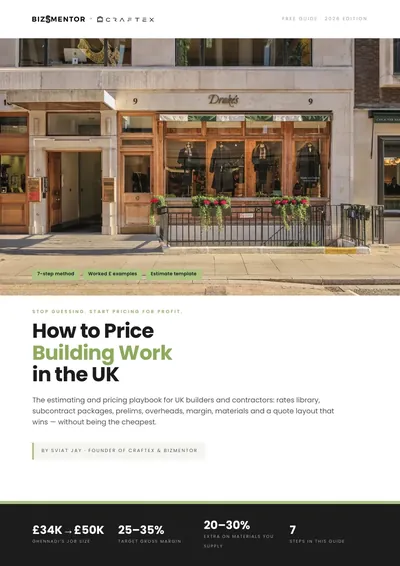
The Builder's Pricing Playbook
The package-by-package estimate sheet and the before-you-send quote checklist, so price rises are covered before you sign.
Get the free guideWant quotes that protect your margin when prices move?
Book a free strategy call.
Before you send your next quote
This is general information from a contractor's experience, not legal or financial advice. For a disputed sum or a contract you're unsure about, speak to a construction solicitor.
Before you go
- Every quote has a validity date and a stated price basis
- Volatile items are provisional sums or ordered at signature
- Any adjustment clause is written, fair, and lets a homeowner cancel
- You know your margin in pounds, not just the price
- Price changes are agreed in writing before you order