
Plumbing & Heating Business Profit Margins: 5 Steps to Keep More of What You Earn
Plenty of plumbers are busy all year and still have little to show for it. The problem is rarely one big mistake — it’s small leaks on every job: guessed prices, free extras, hours nobody checks. This playbook shows how to fix them, with a free Budget and Job Costing spreadsheet built for UK plumbers.
- Gross vs net profit — and how to set your own margin floor
- Your true hourly cost per worker (UK NI, pension and holiday included)
- A simple way to charge for every variation
- Free Budget + Job Costing Excel tools
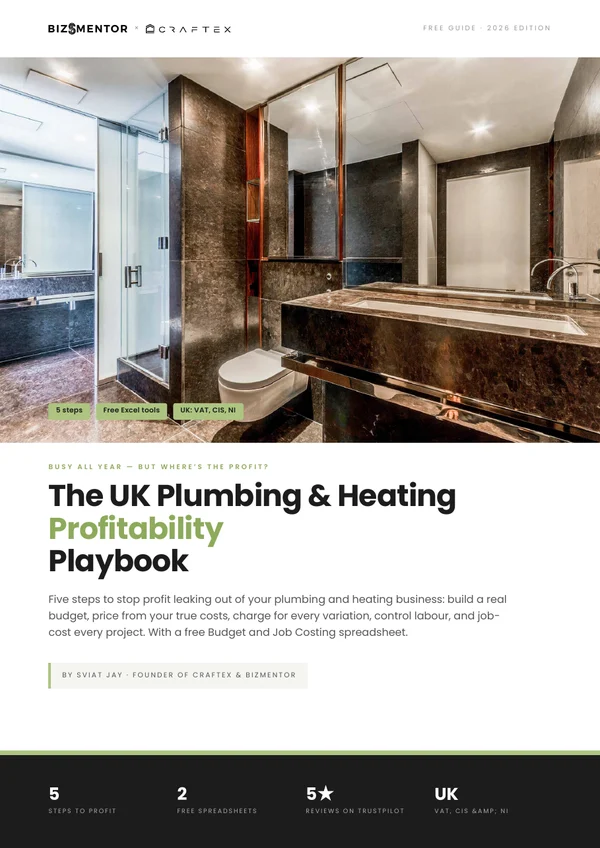
Get the free PDF guide
14 pages. Sent to your inbox in 2 minutes.
The short answer
How to make a plumbing and heating business more profitable:
- Build a budget — turnover by type of work, direct costs, overheads and a fair salary for you.
- Price from your true cost — hours × true hourly cost, plus materials, subs and hire, then divide by (1 − your margin floor).
- Charge for every variation — price it and get written approval before the work is done.
- Control labour — budgeted hours on every job, checked weekly against actual hours.
- Job-cost every job — compare quoted vs actual profit and fix the patterns.
Your margin floor = your overheads % + the net profit % you want. Never quote below it.
Why busy plumbers still struggle to make a profit
Turnover isn’t profit. A plumbing and heating business can turn over a healthy amount and still leave the owner with little at the end of the year. The usual causes: prices based on what competitors charge instead of your own costs, labour priced at the hourly wage instead of the true cost of employing someone, extras done for free, and no record of which jobs actually made money.
Two numbers decide whether the business is worth the stress: gross profit (turnover minus direct job costs) and net profit (gross profit minus overheads, including your own salary). If gross profit is weak, nothing else can fix it.
| Example job | Priced at 20% margin | Priced at a 30% floor |
|---|---|---|
| Direct cost | £6,000 | £6,000 |
| Price | £7,500 | £8,571 |
| Overheads (20% of price) | −£1,500 | −£1,714 |
| Net profit | £0 | £857 |
Example figures. Your overheads and margin floor will differ — the playbook shows how to work out yours.
Budget the year, then price every job from your true cost
Start with a simple annual budget: turnover by type of work (Boiler installs & replacements, Servicing, CP12s & breakdowns, Bathrooms & full plumbing, Heat pumps / commercial), direct costs that move with the work, and overheads you pay every month — vans, insurance, Gas Safe registration, software, accountant, marketing and your salary.
Then work out what each worker really costs. Someone on £18 an hour costs far more once you add employer National Insurance (15% above £5,000 a year in 2026/27), a workplace pension and 5.6 weeks’ holiday — and divide by the hours you can actually charge. In the playbook’s worked example that’s about £27.40 per chargeable hour, not £18.
Work out your margin floor
The free playbook includes a Budget spreadsheet for UK plumbers — blank template plus a worked example.
Charge for every variation
Extra work done before it’s priced is one of the fastest ways to lose margin. On plumber jobs it often looks like this:
- the client upgrades the boiler or cylinder after you have quoted
- extra radiators or moved pipework once floors are up
- a flue route or gas supply that does not meet regs and needs extra work
- the bathroom fitter changes the layout after first fix
The fix is a simple rule: anything not in the quote gets flagged, priced the same day and approved in writing (a text or email is enough) before the work starts — then invoiced at the next stage payment.
Control labour and job-cost every job
Jobs rarely go over budget in one day — they drift an hour at a time. Set budgeted hours before each job starts, show them to the lead on site and compare actual hours every week. After every job, compare quoted vs actual: labour, materials, subcontractors, other costs, gross profit and gross profit per hour. Within a few months you’ll see which types of work, clients and crews make money — and which quietly cost you.
Tax and employment points are general information as of 2026 — check the details with your accountant.
Get the full Profitability Playbook
5 steps, worked examples, a printable margin-floor worksheet and free Budget + Job Costing Excel tools. 14 pages.
Tradesmen who fixed their pricing and profit
Real clients, real numbers. Every story is on YouTube.
“When I first signed up with Sviat, my business was a mess and I was still on the tools. Now we've already hit £400k in revenue this year!”
Ghennadi Catansus · Trustpilot“After just a month and a half, I had earned back everything I'd invested and even made a profit on top.”
Sergey Dimov · TrustpilotIndividual results, not typical or guaranteed. Outcomes depend on your business, market and effort.
Frequently asked questions
What is a good profit margin for a plumbing and heating business?
There’s no single industry number. Work out your own margin floor: your overheads as a % of turnover plus the net profit % you want to keep. If overheads are 20% and you want 10% net profit, every job needs at least a 30% gross margin. Aim for 10%+ net profit after paying yourself a salary.
How do I work out my true labour cost as a plumber?
Add up the yearly cost of employing someone — wages, employer National Insurance, pension and holiday pay — then divide by the hours you can actually charge to clients (after holiday, travel and non-chargeable time). That’s your true cost per hour.
What’s the difference between markup and margin?
Markup is added to cost; margin is a share of the price. A 30% markup on £6,000 gives £7,800 (23% margin). For a 30% margin, divide cost by 0.70: £6,000 ÷ 0.70 = £8,571.
What is job costing?
Comparing the quoted cost and profit of each job with what it actually cost after it’s finished. It shows where you under-estimate, which jobs make money and which crews are most efficient.
Do you guarantee results?
No. Results depend on your business, your market and how consistently you use the systems. The playbook shares what we do in our own company and teach our clients.
Keep going
Get the UK Plumbing & Heating Profitability Playbook
- 5 steps to more profit
- True labour cost and margin floor worked out
- Free Budget + Job Costing Excel tools
From Sviat Jay, founder of Craftex (150+ projects across London) and BizMentor.
Send me the free guide
Free. No spam. Unsubscribe anytime.