How Much Does Adjudication Cost for a Subcontractor?

The short answer
Three costs: a nomination fee of about £250–£425, the adjudicator's fee (fixed at £2,000–£5,000 + VAT for claims up to £100,000 under the CIC low-value procedure, hourly above that) and your own advice, which you usually pay yourself even if you win.
- Nomination fee: about £250–£425 to the body that picks the adjudicator.
- Adjudicator's fee: fixed £2,000–£5,000 + VAT for claims up to £100,000 on the CIC low-value procedure; hourly on bigger claims.
- Your own costs: solicitor or claims consultant. Usually not recovered, even when you win.
- Worth it when the sum is well above the total cost and your paperwork is in order.
You're owed money on a commercial job. The main contractor won't pay, and someone says "just adjudicate". The first question is fair: how much does adjudication cost, and will you get it back?
This guide adds up the real costs for a UK subcontractor. It shows the fixed-fee routes for smaller claims and a simple test for when it's worth it. If you have a sum stuck right now, book a free strategy call and we'll look at it with you.
The three costs of an adjudication
Every adjudication has three costs. Two go to the process. The third, your own advice, is usually the biggest and the one you keep.
| Cost | Typical amount | Who pays |
|---|---|---|
| Nomination fee | About £250–£425 to the body that picks the adjudicator (CEDR £300 + VAT, RICS £425 incl. VAT) | You, when you apply |
| Adjudicator's fee | Fixed £2,000–£5,000 + VAT on claims up to £100,000 (CIC low-value procedure); hourly on bigger claims | Split as the adjudicator decides, usually mostly the loser |
| Your own advice | Whatever your solicitor or claims consultant charges | You, even if you win |
Check your subcontract first. It may name the nominating body, or even the adjudicator. If it names nobody, you can choose a body yourself.
Fixed-fee routes for smaller claims
For claims up to £100,000, ask for the CIC Low Value Disputes procedure. The adjudicator's fee is fixed by the size of the claim, so you know the cost before you start:
| Amount claimed | Adjudicator's fee (+ VAT) |
|---|---|
| Up to £10,000 | £2,000 |
| £10,001 to £25,000 | £2,500 |
| £25,001 to £50,000 | £3,500 |
| £50,001 to £75,000 | £4,500 |
| £75,001 to £100,000 | £5,000 |
| Over £100,000 | Negotiable |
The documents must be short: all papers should fit in one A4 lever arch file. That keeps your own preparation cost down too.
RICS also runs summary adjudication for claims under £20,000. The adjudicator's fee is capped at £1,000 + VAT and a decision normally comes within 14 days. Check with RICS whether your contract and the other side allow it before you apply.
Not sure adjudication is worth it for your sum?
Book a free call with our team. We'll go through what you're owed, your paperwork and the cheapest route to the money.
Who pays at the end
The adjudicator decides who pays their fees. Usually the losing side pays most or all of them. But both sides are jointly and severally liable. If the main contractor doesn't pay its share, the adjudicator can come to you.
Your own legal costs are different. An adjudicator has no general power to make the other side pay them. Plan on paying your solicitor or claims consultant yourself, whatever the result.
Watch for a clause in your subcontract that says you pay the other side's adjudication costs whatever happens. Under section 108A of the Construction Act, most clauses like that don't work. If you see one, get advice before you let it put you off.
Assuming "we'll win, so they'll pay". Even a clear win usually leaves you with your own costs. Count them before you send the notice.
When adjudication is worth it
Do the sum before you start. Add the nomination fee, the adjudicator's fee and a written fixed-fee quote from your adviser. Then compare it with the money you'll actually get.
An example. A subcontractor is owed £18,000. On the low-value procedure the adjudicator's fee is £2,500 + VAT and the CEDR nomination fee is £300 + VAT. That's £2,800 + VAT before advice. If the adviser's fixed fee still leaves most of the £18,000, it's worth it. If it eats half, look at cheaper routes first.
| Route | Best for | Time | Main cost |
|---|---|---|---|
| Formal letter + statutory interest | Any unpaid sum, as step one | Days | Your time |
| 7-day suspension notice | Sums due by the final date and not paid | 7 days' notice | Lost time on site |
| Small claims (county court) | Simple debts up to £10,000 | Months | Court fee on a sliding scale |
| Adjudication | Disputed sums on a construction contract | 28 days from referral (+14 with your consent) | Fees above + your advice |
Adjudication is usually worth it when three things are true. The sum is well above the total cost. Your paperwork is in order. And the other side can actually pay. A decision against a company that is going bust may never be paid.
Not sure your sum is worth adjudicating?
Book a free strategy call and we'll go through the numbers and your paperwork with you.
Six ways to cut the cost
Most of the cost is time: yours and your adviser's. A tidy file costs less to argue.
- Keep one file per job: applications, payment notices, pay less notices, instructions and dated photos.
- One dispute per referral: an adjudicator decides one dispute. Keep it focused on the money you're owed.
- Use the fixed-fee procedure: on claims up to £100,000, ask for the CIC low-value procedure.
- Try the cheap levers first: a formal letter, statutory interest and a 7-day suspension notice often get the money paid.
- Get a fixed-fee quote: ask your adviser for a fixed price for the whole adjudication, in writing.
- Check the deadlines: you refer within 7 days of your notice. Missing it can mean starting again.
The cheap levers are set out step by step in what to do when a main contractor isn't paying. If the trouble started with a deduction, check it first with our pay less notice 7-day plan.
Stop needing adjudication at all
Adjudication is the fire extinguisher. The real fix is getting paid in full without a fight. That comes down to three things: clear subcontract terms, applications that are hard to argue with, and cash that doesn't depend on one late payer.
This is the paperwork our commercial management service runs for contractors. Joe Crawford, Craftex's Commercial Director, has 37+ years in commercial construction.
Sviat Jay runs Craftex, a London main contractor, and mentors owners one to one himself. He sees payment disputes from the side that issues the notices, so he shows you where your applications are weak. The aim is results in about 4 months, not the 1–3 years many coaching programs take.
Want fewer disputes and steadier cash? Book a free strategy call. Or score your business in 4 minutes with the free Construction Business Scorecard.
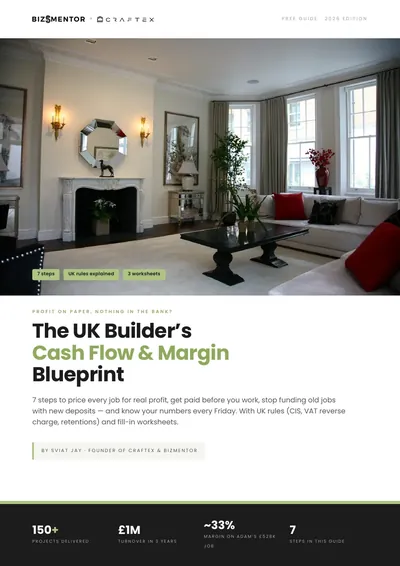
The Cash Flow & Margin Blueprint
Payment terms, the UK rules that protect your cash, and a fill-in payment schedule so fewer sums end up in a dispute.
Get the free guideThis is general information on the rules in England and Wales as of October 2026, not legal advice. Fees are as published by the nominating bodies and may change. For a large or complex claim, speak to a construction solicitor.
Before you send a notice of adjudication
- You have added up nomination, adjudicator and advice costs
- Your adviser's fee is fixed and in writing
- Your file has every application, notice and instruction
- The dispute is one clear sum you can prove
- The other side can actually pay