How to Start a Construction Company With No Money

The short answer
You can start with almost nothing: registering as a sole trader is free and a limited company costs £100 online. Use the tools you already own, start with labour-only or small jobs, take a deposit and stage payments so the client's money buys the materials, and find the first clients by calling, not by paying for ads.
- Registration is cheap. Sole trader: free with HMRC. Limited company: £100 online at Companies House.
- Start labour-only or small, and skip the big spends. No new van, agency website or paid leads in month one.
- Let the client fund the job. Deposit before you order, every stage paid before it starts.
- Put tax aside from day one. CIS deductions, income tax and, past £90K turnover, VAT.
Most tradespeople who want their own company don't have £20K in the bank. They have their tools, their skill and a phone full of people they've worked with. The good news: that's enough to start.
Sviat arrived in London broke and worked on site as a demolition labourer. He became a carpenter and built his own construction company, Craftex. Nobody gave him start-up capital.
This is how to start a construction company with no money in the UK, the low-cost route he teaches. It covers what you must pay for, what can wait and how client money funds the job. Want a plan for your trade? Book a free strategy call.
What starting a construction company really costs
The legal part is cheap. Most of the money people "need" goes on things that can wait.
| Item | Do you need it on day one? | Cost |
|---|---|---|
| Register as a sole trader with HMRC | Yes, or a Ltd | Free |
| Register a limited company at Companies House | Optional at the start | £100 online, usually within 24 hours |
| CIS registration as a subcontractor | Yes, if you'll work for contractors | Free to register; unregistered = 30% deducted instead of 20% |
| Employers' liability insurance | Only once you employ someone | Required by law, minimum £5M cover |
| Public liability insurance | Strongly advised | Not a legal requirement, but many clients and contractors ask for it |
| Tools | Use what you own | Hire or buy the rest per job, priced into the quote |
| New van | No | Use what you have until the work pays for it |
| Agency website, logo, paid leads | No | Later, once you can price and close |
There is no general licence to run a building company in the UK. Some work is regulated: gas work needs a Gas Safe registered engineer, and some electrical work must be certified. If your trade has rules like this, follow them from day one.
Sole trader or limited company: which to choose
Both work. The choice is about how you want to look to clients and how much paperwork you want in year one.
- Sole trader Free, simple, you and the business are the same in law.
- Limited company £100, separate from you, looks more serious to main contractors and bigger clients.
- Either way Register for CIS, keep a separate bank account, and put tax aside from every payment.

Many trades start as sole traders and move to a Ltd as turnover grows. Ask an accountant about the tax for your numbers. More detail in how to structure a construction company.
Still worried you can't afford to start?
Book a free call with our team. We'll plan your first jobs so the client's money funds the work.
Start labour-only or small
The fastest way to start with no money is to sell what you already have: your skill and your time. No materials to fund, no big risk, and you get paid from week one. Not sure yet if starting is worth it? See the honest numbers for 2026.
- Labour-only for main contractors. They supply materials and pay you for the work. Offer a few people on a day rate to get in.
- Small private jobs. Repairs, single rooms, one package. Low materials, quick payment.
- One trade package on a bigger site. Grow the job from the inside once they trust you.
Oleg, 19: from £100 a day on site to £7K a month profit
He started his own company, went out and found his own projects, and built a team of 10+ people within two months. Individual results, not typical or guaranteed.
Not sure whether to start labour-only or go straight to your own clients?
Book a free call and we'll pick the route that fits your trade.
Let the client's money fund the job
When you move on to supply-and-fit or full jobs, never fund them from your own pocket. Build the payment schedule so you're always paid before you spend:
- A deposit before you order anything. Big enough to cover what you buy and commit to.
- Long-lead items paid upfront by the client, or ordered on their account.
- Each stage paid before it starts, not after it's finished.
- A written contract with the schedule in it, signed before day one.
Our clients do this from their first jobs. Clayton, a plasterer, signed a £10K project on day one with £5K upfront and staged payments. Sergey turned a £2K enquiry into a £15K first deal with 50% upfront. Individual results, not typical or guaranteed. Here's how much deposit a builder should take.

Taking a big job without a deposit because you're scared to lose it. If the client won't pay for materials before you order, you're the bank. With no savings, one late payer can end the company.
Get the first clients without spending on ads
Your marketing budget in month one is your phone. Write down everyone you know in construction and call them, don't text:
- former employers and site managers;
- colleagues and other trades;
- subcontractors and suppliers;
- past private clients, friends and family.
Tell each one you now run your own company and what you deliver. Say you pay a referral fee for an introduction that turns into a job.
Don't underestimate anyone in your phone. Friends, other builders, even family can bring you a deal.
Then walk onto live sites near you, ask for the project manager and offer something small first. Leave Checkatrade, MyBuilder and paid ads until you can qualify, price and present well. The full 30-day plan is in set up a construction company but no work.
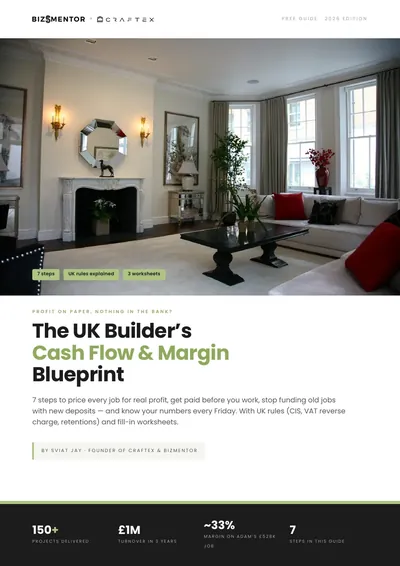
The Cash Flow & Margin Blueprint
Price for real profit and get paid before you work: deposits, stage payments and a cash-flow plan for UK builders. Free.
Get the free guidePut tax aside from day one
Starting with no money is fine. Ending year one with a tax bill and no money isn't. Your first January bill also includes a payment on account (see the worked example). Three things to plan for:
| Tax | What happens | What to do |
|---|---|---|
| CIS | Contractors deduct 20% from your labour if you're registered, 30% if not | Register before your first contractor job; the deductions count towards your tax bill |
| Income tax / corporation tax | Due on your profit | Move a fixed share of every payment into a separate account |
| VAT | You must register once taxable turnover passes £90,000 in 12 months | Watch your rolling 12-month total and price VAT into quotes before you hit it |
Want to see where your new business is weakest? Take the free 4-minute Construction Business Scorecard: 18 questions on your pipeline, sales, pricing, cash flow and systems, with your weakest area shown first.
What to stop spending money on
| Feels like starting a business | Do this instead |
|---|---|
| Financing a new van | Use the one you have until the jobs pay for it |
| Paying an agency for a website | A simple page with your trade, area, photos of your work and a phone number |
| Buying leads before your first job | 300 calls to people who already know you |
| Every tool for every job | Hire or buy per job and price it into the quote |
| Waiting for a partner or more experience | Your first small job this month |
If you want to go faster, the gap is rarely money. It's knowing how to price, sell and run the cash.
That's what one-to-one mentoring with Sviat fixes. The owner of a working construction company, Craftex, works on your trade, your area and your strengths. It's not a standard program built for hundreds of businesses. Programs are built for results in about 4 months, not 1–3 years. To start, book a free strategy call.
Individual results, not typical or guaranteed. The full step-by-step is in our guide to starting a construction business.
Your no-money start checklist
- Registered with HMRC (sole trader) or Companies House (£100), plus CIS
- Separate bank account and a tax pot from the first payment
- Contact list written and 300 calls made
- First jobs labour-only or small, every one with a deposit
- Stage payments in a written contract before you start