Construction Variations: How to Get Paid for Extra Work


The short answer
Spot it, tell the client in writing, price it, get it agreed before you start, then bill it with the next payment. Extra work done on a nod is the work you most often never get paid for.
- A variation is any change to the agreed work: more, less, different spec, different sequence, access or working hours.
- Agree it before you do it. A one-line email the client replies 'agreed' to beats a perfect form signed three weeks later.
- Price from contract rates and bill with the next payment. A variation left to the final account becomes a negotiation.
- Can't agree a price in time? Record it daily on dayworks sheets the client signs, and price it later.
The client walks the site and says, "While you're here, can you move that door?" You say yes. Three weeks later the final invoice includes £1,850 for the door, and the client says, "I thought that was included."
That conversation costs UK builders and subcontractors more money than almost anything else. Not because the client is dishonest, but because nothing was agreed in writing before the work was done.
Here's how to get paid for construction variations, whether your client is a homeowner or a main contractor. If extras keep eating your margin, book a free strategy call and we'll look at how you record and bill them.
This is general information from a contractor's experience, not legal advice.
What counts as a variation
A variation is any change to the work you agreed to do. On JCT contracts the definition is wide. It isn't only "more work":
- Added work: an extra socket, another room, a bigger opening.
- Omitted work: the client takes something out. That reduces the price, but it can also cost you overheads you'd priced across the job.
- Different spec or quality: a different tile, a heavier steel, a better grade of timber.
- Order, access or hours: you're told to work evenings, wait for another trade, or lose the parking you priced on.
- Design changes: a revised drawing after you priced from the old one.
The last two are where most money is lost, because builders don't recognise them as variations at all.
Treating "small" changes as goodwill. Ten £300 changes is £3,000, and they're the first thing a client forgets.
If the real problem is a client who keeps changing their mind, start with a decision schedule and a reset conversation. Then use the process below.
The 5-step process that gets variations paid

- Spot it. Train yourself and your site lead to ask one question whenever a client, architect or main contractor asks for something. "Is this in the price?"
- Tell them in writing, the same day. Before you price it, confirm the request: "You've asked us to move the door to the left of the chimney breast. This isn't in our quote. We'll send a price by Thursday."
- Price it. Use your contract rates where you can (see below), include any extra time, and say if it moves the finish date.
- Get it agreed before you start. A reply email saying "agreed" is enough on most small jobs. On JCT work, ask for the instruction in writing from the person allowed to give it.
- Bill it with the next payment. Add agreed variations to the next stage invoice or payment application. Never park them for the final account.
Still losing money on extra work?
Book a free call with our team. We'll show you how to record, price and bill every variation.
How to price a variation
Clients argue with prices they've never seen before. They argue far less with rates they already accepted. That's why JCT contracts value variations in this order, and it's a good order for any job:
| Situation | How to price it |
|---|---|
| Same kind of work, same conditions | Your contract or quote rates |
| Similar work, different conditions or quantity | Contract rates adjusted, with the reason stated |
| Nothing similar in the contract | Fair price: cost plus overheads and margin |
| Can't be measured or priced in advance | Dayworks: labour, plant and materials at agreed rates |
Don't forget what a change does to the rest of the job:
- Extra days on site mean extra prelims: scaffold hire, skips, welfare, supervision.
- Changes in sequence can mean return visits, which are labour you didn't price.
- Re-ordering materials can mean restocking fees and delivery charges.
- If the finish date moves, say so in the same email as the price.
Dayworks: when you can't agree a price in time
Sometimes the work has to happen before a price can be agreed. You open a wall, find rotten timbers, and the room can't be left open. That's what dayworks sheets are for.
- Record it daily. Names, hours, plant, materials and what was done, on a sheet for each day.
- Get it signed the same day by the client, architect or main contractor's site manager. Signed means "the time was spent", not "I agree the price", but it settles the facts.
- Agree the rates upfront. Put daywork rates (or the basis for them) in your quote so they're not argued later.
- Add photos. Before, during, after, with the date.
Losing money on extras you can't prove?
Book a free call and we'll show you how to record and bill them.
The variation form and register
You don't need software. You need one form per change and one list of all of them.
What every variation form should say:
- Variation number and date
- Who asked for it and how (on site, email, drawing revision)
- What changes, in plain words
- The price, with how you worked it out
- Any change to the finish date
- When it will be paid (for example, with the next stage)
- Client's signature or written "agreed"
A variation register keeps the running total in front of you and the client. Example (illustrative):
| No. | Change | Asked by | Price | Agreed | Billed |
|---|---|---|---|---|---|
| V01 | Move door to left of chimney breast | Client, on site 3 Mar | £1,850 | Email 4 Mar | Stage 3 |
| V02 | Upgrade to engineered oak flooring | Client, email 10 Mar | £1,350 | Email 10 Mar | Stage 4 |
| V03 | Extra 2 double sockets, kitchen | Client, on site 12 Mar | Price sent 13 Mar | Waiting | Not started until agreed |
Send the updated register with every invoice. A client who sees £3,200 of extras building up is never surprised by the final account.
If the client refuses to pay
Start with facts, not frustration. Put every disputed variation in one email: who asked, when, what you did, the price and your evidence (emails, texts, photos, dayworks sheets). Ask for the undisputed part of the account to be paid now.
Then it depends who the client is:
| Client | Your main route |
|---|---|
| Main contractor, developer, business | Include variations in your payment application; challenge late or missing notices; adjudication if needed |
| Homeowner in their own home | Written summary, then mediation, then the small claims track (up to £10,000 in England and Wales) or a solicitor for larger sums |
On homeowner jobs where no price was agreed, the law gives you a reasonable price for work the client asked for. On commercial work, see how to respond to a pay less notice and what to do if a main contractor isn't paying. If the argument is about the very last invoice, see client won't pay the final invoice.
Don't stop the main job over a disputed variation. Stopping without a contractual right can put you in breach. Keep working on what's agreed and keep the variation in writing.
Write it into the contract before you start
The easiest variation to get paid is the one your contract already planned for. Before the next job starts, make sure your quote or contract says:
- How changes are asked for and agreed (in writing, by whom).
- How they're priced (quote rates, daywork rates).
- When they're paid (with the next stage, or upfront for big changes).
- Exclusions and provisional sums, so "I thought that was included" has an answer.
If you use JCT, our guide to JCT contracts for UK builders explains how the forms handle instructions. For private clients, see why we often advise a bespoke contract. If extras are the reason a job is now losing money, read underquoted a job: what to do.
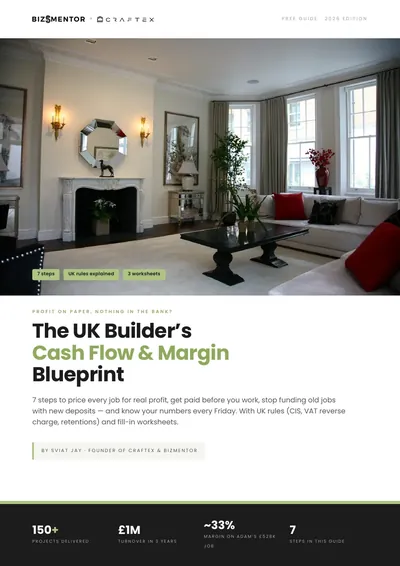
The Cash Flow & Margin Blueprint
Payment terms, the UK rules that hit your cash, and a fill-in payment schedule.
Get the free guideVariations checklist
To score how well your business protects its margin, take the free 4-minute Construction Business Scorecard. Want a commercial team to price, record and recover variations for you? Our commercial management service runs the same system Craftex uses on its own projects.
Want the whole business fixed, not just the paperwork? 1-to-1 mentoring with Sviat, who runs Craftex today, can help. BizMentor mentoring aims for results in about 4 months rather than 1–3-year programs. Book a free strategy call to start.
Before you start any extra work
- You've asked "is this in the price?"
- The request is confirmed in writing the same day
- The price and any time change are sent before you start
- You have a written "agreed" from the right person
- It's on the register and billed with the next payment