How to Price Plastering Jobs: A Guide for UK Plasterers

The short answer
Price a plastering job from the hours it will really take, costed at your true hourly rate, plus materials, waste and travel, then divide by (1 − your margin floor). Use the m² rate to check the price, never to make it.
- A skim rate is not a price. In our example a re-plaster works out at about £46 a m², nearly double a typical £24 skim rate, because of hacking off, beads and a backing coat.
- Survey before you quote. Artex, blown plaster, damp, high ceilings and a full house of furniture all change the hours.
- Hours × true hourly cost. Not the wage you pay: with NI, holiday, van and tools, our example rate is £27.40 an hour.
- Write what is included. Coats, beads, prep, waste and making good. Anything else is an extra, priced before you do it.
Most plasterers price the way they were shown on site: a rate per m², a rate per room, or "about £300 a day". Then a skim turns into a hack-off, the ceiling is artex, the client is still living in the house, and a two-day job takes four.
This guide shows how to price plastering jobs so every quote makes money. It is for owners of UK plastering businesses. Want your rates checked against a real job? Book a free strategy call.
For setting your margin floor and true hourly cost, see our plastering and drylining margin guide. This page is about pricing the job in front of you.
Why one skim rate loses money
A homeowner cost guide is a good market check. Checkatrade's June 2026 guide puts skim plastering at about £24 per m² and an average day rate at about £300. But those are averages across very different jobs:
- Skim over sound plaster in an empty room: quick, low risk
- Skim over artex or painted walls Extra prep, bonding coat, more time
- Re-plaster Hack off, beads, backing coat, then skim
- Overboard and skim a ceiling Boards, fixings, often two people
- Render outside Scaffold, weather, longer drying
Quote all of them at one rate and you win the easy jobs and lose money on the hard ones.
Know your numbers before you price anything
You need two numbers from your own books:
- True hourly cost. Wages plus employer NI, pension, holiday, van, tools and insurance, divided by the hours you can actually charge. In our example that is £27.40 an hour, not the £18 wage.
- Margin floor. Your overheads as a % of turnover plus the net profit you want. With 20% overheads and 10% profit, nothing goes out below a 30% gross margin.
Every price on this page is cost ÷ (1 − margin floor). At 30%, that is cost ÷ 0.7. The margin guide shows how to work out both numbers step by step.

Survey the job before you quote
Never price a full room or house from a photo. On the visit, check:
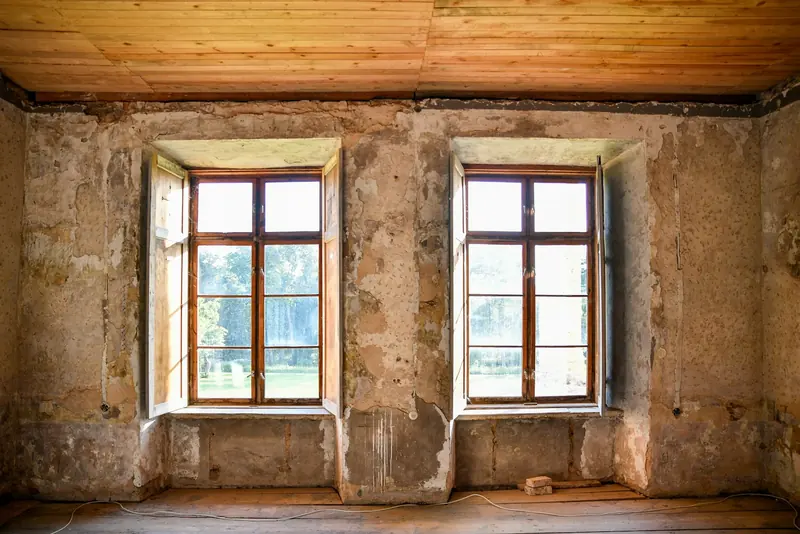
- what is on the walls: sound plaster, artex, paint, wallpaper, blown or hollow areas
- damp, cracks, old lath and plaster, and what is behind it
- ceiling heights and access: stairs, scaffold towers, a loft hatch
- furniture, flooring and people: an empty room or a lived-in house
- parking, water, power and where the waste goes
Tap the walls. Hollow sound means hacking off, and hacking off means a different job. Write what you found on the quote, so if more is found later, it is an extra and not your loss.
Price the hours, job type by job type
The area tells you how much. The job type tells you how long. These are what add hours on each type:
| Job type | What adds hours |
|---|---|
| Skim over sound plaster | Protection, PVA, angles, number of rooms |
| Skim over artex or paint | Scraping or bonding coat, extra coat |
| Re-plaster (hack off) | Hacking off, rubble out, beads, backing coat |
| Overboard and skim ceiling | Boards, fixings, two people overhead |
| Float and set / hardwall | Backing coat, drying time, return visit |
| External render | Scaffold, mesh, beads, weather days |
Use your own outputs. If you do not know how many m² you skim in a day, job-cost the next three jobs and write the actual hours down. After a month you will price from your numbers, not from memory.
Not sure your hourly cost and outputs are right?
Book a free strategy call and we will check them with you.
A worked example: re-plastering a bedroom
Bedroom, 4 m × 3.5 m, 2.4 m ceiling (example figures). Walls about 32 m² after the door and window. Ceiling 14 m², artex, to be overboarded. Total 46 m².
| Task | Hours | Cost £ |
|---|---|---|
| Protection and set-up | 2 | 54.80 |
| Hack off walls, rubble out | 8 | 219.20 |
| Beads and angles | 2 | 54.80 |
| Backing coat, walls | 8 | 219.20 |
| Overboard ceiling | 4 | 109.60 |
| Skim walls and ceiling | 10 | 274.00 |
| Clean-up | 2 | 54.80 |
| Labour at £27.40/h | 36 | 986.40 |
Then add what is not labour:
Direct cost: £1,486.40. At a 30% floor the price is £1,486.40 ÷ 0.7 = £2,123, quoted as £2,125 (plus VAT if you are registered). That is about £46 per m².
Now the check. At a £24 skim rate you would quote £1,104. That is £382 less than it costs you, before a penny of overheads. The rate looked "market". The job was not a skim.
Taking the cheapest quote you have heard of as your price. You do not know their hours, their costs or whether they are still in business next year.
Day rate, m² rate or fixed price: when each works
Use each method where it fits, and build all three from the same hourly cost:
| Method | Use it for | Watch out for |
|---|---|---|
| Fixed price per job | Homeowners, rooms, full houses | Write inclusions and exclusions, or extras become free |
| Rate per m² | Measured work for builders and main contractors | Separate rates for skim, re-plaster, boarding and render |
| Day rate | Patching, unknown scope, agreed dayworks | Agree it in writing first; minimum half day |
Homeowners compare totals, so give them one clear price. Builders compare rates, so give them a rate schedule. Either way, the number underneath is hours × true hourly cost ÷ (1 − margin floor).

UK Plastering & Drylining Profitability Playbook
Turn your hours into true m² rates and job-cost every skim, re-plaster and drylining package.
Get the free guidePrice for the client, not just the wall
The same 46 m² is a different job for different clients:
- Homeowner. Lived-in house, more protection, more questions. Take a deposit for materials and get paid on completion, the same day.
- Builder or developer. Faster, empty rooms, but more pressure on rate and programme. Agree payment dates before you start.
- Main contractor. CIS takes 20% of your labour if you are registered (30% if not, unless you have gross payment status), and retention is often held. Build the wait into your price and your cash plan.
If you are close to £90,000 of taxable turnover in a 12-month period, you must register for VAT. Price with it in mind before you reach it, not after.
For a four-minute score of your pricing, cash, sales and systems, take the free Construction Business Scorecard.
Write a quote that protects your margin
A quote is not a number on a WhatsApp message. Put in writing:
- Areas and work. Each room, walls and ceilings, coats, boarding and beads
- Preparation. Protection, hacking off, bonding, what you found on the survey
- Exclusions. Damp treatment, electrics, making good after other trades, decorating
- Payment. Deposit, stage or completion, and the date it is due
- Extras. Priced and agreed in writing before you do them
When the client asks for "just one more wall", price it there and then. See how to get paid for variations for how to do it without an argument.
When to walk away from a job
Some jobs cost you money however well you plaster:
- the client wants your price to match "a mate who does it for less"
- there is no time to survey, but they want a fixed price today
- the scope is "a bit of patching" across a whole house with no list
- the payment terms are 60 days on a job you can only fund for 30
Saying no to a bad job keeps a day free for a good one. A full diary at a loss is still a loss.
What this looks like in practice. Liam, a plasterer in our mentorship, signed a £79K house renovation six weeks in and built a £1M pipeline. Individual results, not typical or guaranteed.
Once your prices carry a wage, read how to grow a plastering business for the hiring order and the systems that follow.
Sviat Jay runs a working construction company, Craftex, and mentors owners one to one himself. Every plastering business is different: one owner is strong on the tools, another on sales. Working one to one, he builds on what you are already good at.
He is aiming for results in about 4 months rather than 1–3-year programs. To price your next job with us, book a free strategy call.
Want your plastering prices built from your own numbers?
Book a free strategy call.
Before you send your next plastering quote
Tax points are general information as of October 2026. Check the details with your accountant.
Before you go
- You surveyed the job and wrote down what you found
- Hours are estimated task by task, not from a skim rate
- Labour is costed at your true hourly cost, not the wage
- Materials, waste and travel are in, and the price is cost ÷ (1 − floor)
- Inclusions, exclusions and payment terms are in writing