How to Get Work From Architects as a Builder

The short answer
Target small studios (3–10 people) with live private projects. Call first, then visit, and offer to help price their designs. Prove you price honestly and deliver, then follow up by phone every week until you're on their tender list.
- Most practices are small. 3,018 of 3,738 RIBA chartered practices (about 81%) have fewer than 10 staff, and for them private housing is more than half of revenue.
- Architects pick and pay builders. They invite and appraise builders' tenders, then value the work and certify payments on the contracts they run.
- Lead with pricing help. Their clients always ask for a construction budget, and most architects know design better than building costs.
- Old contacts first. Adam & Ali's £528K project came from an architect they had worked with before. Individual results, not typical or guaranteed.
Most builders wait for architects to find them. The ones who grow go and find the architects, and give them a reason to put their name on the tender list.
Here is how we do it, step by step, with the scripts. If you'd rather build your architect list with us, book a free strategy call.
Why architects matter to a builder
On architect-led jobs, the architect shapes who builds it and how they get paid. RIBA's own guide for homeowners says the architect can help select the builder and invite and appraise builders' tenders. The architect then values the work and certifies payments.
So one good architect relationship can feed you projects for years. And architects need you as much as you need them:
- Their clients always ask for a construction budget, and most architects know design better than building costs.
- Small studios struggle to find reliable builders. Turning up when you said you would already sets you apart.
- A builder who prices honestly protects their reputation with the client.
Skip the big firms — their projects are huge and their tender process is strict. Small studios struggle to find reliable builders, and that's your opening.
Pick the right architects
Most of the market is small. Of 3,738 RIBA chartered practices, 3,018 (about 81%) have fewer than 10 staff. For those small practices, private housing is more than half of revenue. That's extensions, refurbishments and new homes: the work a growing builder wants. (Before you price one, see how to price loft conversions and extensions.)
Target studios of 3–10 people with live private projects. Find them three ways:
- Planning approvals. Your council's planning portal shows each application with the applicant and, usually, the architect.
- LinkedIn and Google. Search "architects near me" and check each studio's recent projects.
- Architects working outside their usual area. They don't have local builders yet.
Working in prime London? See how to get high-end clients as a London builder for interior designers, neighbours and referral programs too.
Then decide which projects you actually want. Write down your A-grade job and drop everything else:
| Filter | Example |
|---|---|
| Type of work | Extensions & refurbs, office fit-outs |
| Value | £100K–£400K |
| Area | Within an hour of the yard |
| Route in | Architect-led private clients, small developers |
| Margin you need | 20%+ gross |
Is the gap in your pipeline or in how you convert enquiries? Take the free 4-minute Construction Business Scorecard: 18 questions on your pipeline, sales, pricing, cash flow and systems, with your weakest area shown first. Want the enquiries handled for you? See our construction marketing service.
Get your proof ready before the first call
The first thing an architect does after your call is look you up. If your website and documents don't back up what you said, the call was wasted.
- One sentence. "We're [Company], a [type] contractor in [area]. We specialise in [projects] from £[x] to £[y], and clients use us because [proof]."
- A website with recent projects, photos, a few reviews and a phone number that gets answered.
- A proof pack: 2–3 case studies of similar jobs as a PDF you can email after the call.
- One CRM with every architect, call note and call-back date.
Adam & Ali's business looked like a maintenance company, so it only got £200–£10K jobs. We built a capability statement in 2 days with their best 4–6 projects. Bigger clients judge you before they speak to you.
Make the first call
Spend three minutes first: the architect's website, the planning drawings, and one detail to mention. Don't call on the day an approval comes out. Everybody does. A week or two later, your call stands out.
| Part | What you do |
|---|---|
| 1. Hello | Name, company, where you're based, in one breath |
| 2. The job | Name the project and ask for their help |
| 3. Why you | One reason you fit: similar job, local team, case study |
| 4. Listen | Let them talk; write it down |
| 5. Ask | Stage, tender date, who prices, budget, QS, when to call back |
The script:
"Morning [Name], it's [You] from [Company]. We're a [type] contractor based in [area]. Have you got two minutes?"
"I saw the approval for [address]. It's very close to a [similar project] we finished in [area]. Could I ask where you are with it?"
"Is it going out to tender? Who's putting the tender list together, and is there a QS on board?"
"We'd really like to price it. When's a good time for me to call you back? And while I've got you, anything else coming up we should know about?"
If it goes to voicemail, leave a message under 25 seconds: who you are, the project, a similar job you've finished, and your number twice.
On LinkedIn, offer work instead of asking for it.
Don't write "Hi, my name is John from XYZ Ltd, do you have any jobs?" Nobody replies. I'm offering them work, not asking for it. This is what I write:
"Hi, I'm looking for partners and I have a potential project — would you like to talk about it?"
Not sure what to say on your first architect call?
Book a free call and we'll write your one-sentence answer with you.
Offer to help price their projects
This is the move most builders miss. Call first to check the studio has a real office. Then visit in person and offer to help estimate their projects and visit sites with them.
Start with jobs up to about £100–150K. As the studio gets to know you, build towards around £500K.
When a project goes to tender, treat your price as a sales document:
- Find the real decision maker early: client, architect, QS or a family member.
- Make it look professional: cover letter, clear breakdown, programme and payment stages.
- Add a cost-saving appendix: options that save money without touching the main price.
- Submit on time or early. If you can't, tell the architect straight away.
- Call to confirm receipt, then again a week later.
This is a numbers game. Before you price, speak to both the architect and the client. Make sure the client receives your quote at the same time as the architect.
Before you spend a week pricing, ask: have you secured the project? How many contractors are pricing? Is there a preferred contractor? What matters most: price, programme or quality? If the answers are bad, don't price it. Not sure how to price architect-led jobs for margin? Book a free strategy call and we'll go through one with you.
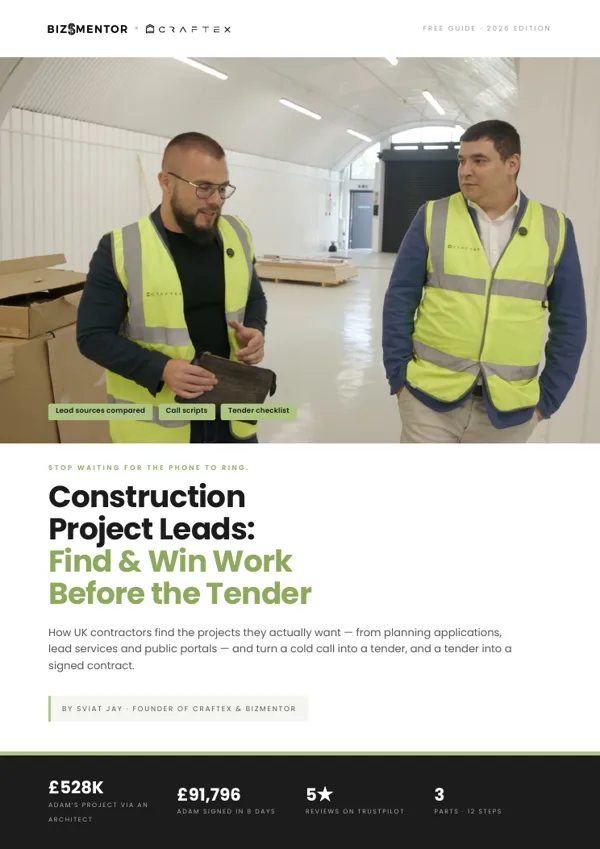
Construction Project Leads Guide
First-call and voicemail scripts, the A-grade project filter and a project lead tracker.
Get the free guideFollow up until you get a yes or a clear no
Nobody hands a stranger a big budget after one call. It usually takes several touches before you're trusted with a tender: a call, an email, a call back, case studies, a meeting.
- Promise one small thing on every call, like an email or case studies, and do it the same day.
- Call back at exactly the time you agreed. It proves you turn up when you say you will.
- Follow up by phone every week until you get a yes or a clear no. Email alone gets ignored.
- Lose well: thank them, ask who won and why, and ask what's next.
Set a weekly rhythm and stick to it. Monday: pull new approvals. Tuesday and Thursday mornings: 8–10 new calls plus follow-ups. Friday: send everything you promised. Expect to talk to many architects to get a handful of tender invitations a month. The numbers grow as people start to know you.

Case: a £528K project through an architect
Adam & Ali, two partners running a UK construction business, were stuck at around £500K a year for three years. Their average job was £2,700.
They started with the contacts they already had. Calling every old contact surfaced a £145.6K lead from an architect they had worked with before. They added LinkedIn outreach to architects and designers.
The result: a £528K project won through an old architect contact, at ~34% margin: £175–180K estimated profit. It took 4 months and 9 one-to-one calls.
Adam & Ali: £500K a year to a £528K project
The full story: rebrand, pricing, sales and the architect contact that brought the biggest job. Individual results, not typical or guaranteed.
Your old contacts are the warmest architects you have. Call them before you cold-call anyone. The same weekly routine works for developers too: see how to get work from property developers.
Want a 90-day plan to get on architects' tender lists?
Book a free strategy call.
Before your next architect call
- You have a list of 3–10-person studios with live private projects near you
- Your website, one-sentence answer and proof pack are ready
- You've done 3 minutes of prep on the architect and the drawings
- You'll offer to help price their projects, not just ask for work
- Every call has a call-back date in your CRM