How to Hire a Salesperson for a Construction Company


The short answer
Hire a salesperson only once your own sales process works and you have more enquiries than you can follow up. Write the process down, pick the right kind of role, pay commission on gross profit, test them with a live quote and give them a 90-day plan.
- Process first, person second. A salesperson can only run a sales process you already have and can write down.
- Pick the role you need: someone to follow up enquiries and quotes, someone to sell at site visits, or someone to bring in commercial work.
- Pay commission on gross profit, not turnover, and set a price floor only you can go below.
- Test with a real quote in the interview, then give them a 90-day plan and weekly numbers.
Most owners look at how to hire a salesperson for a construction company when they are drowning. Enquiries go unanswered, quotes are never chased and every site visit is in their diary. A good hire fixes that. A bad one costs a wage and a year of discounted jobs.
This guide covers when you are ready and which kind of salesperson to hire. Then how to pay them, how to test them and their first 90 days. Not sure a salesperson would pay for itself yet? Book a free strategy call.
Signs you are ready to hire a salesperson
You are ready when you lose work because nobody has time to sell, not because nobody wants to buy. Look for these signs:
- Slow call-backs. New enquiries wait more than a day for a call.
- Unchased quotes. Quotes go out and nobody follows them up.
- Owner bottleneck. Every site visit, quote and meeting needs you.
- A process that works. When you do sell properly, you win at your margin.
You are not ready if there are too few enquiries, or your prices only win when you cut them. A salesperson cannot fix either. Fix the leads or the price first. See how to qualify construction leads and how to charge more without losing clients.
In Sviat Jay's usual hire order, sales comes after admin, a site lead, an estimator and a project manager. Those roles free you to sell. More in hiring your first employee.
Still doing every site visit and quote yourself?
Book a free call with our team. We'll look at your sales process and tell you whether a salesperson would pay for itself yet.
Write your sales process down first
A salesperson can only run a sales process that exists. If it lives in your head, they will make up their own.
Write down each step, from first call to signed contract:
- First call. Call back the same day. Ask about budget, timing and who decides.
- Site visit. Measure, listen and book the quote meeting before you leave.
- Live quote. Present the quote in person or on video, not by email.
- Follow-up. Same day, day 2–3, day 7, then weekly until yes, no or a decision date.
Ghennadi, a decorator from Northampton, moved to a 4-step sales system like this. He stopped emailing quotes and presented them live. His projects grew from £34K to £50K, and he went from £2K a month on the tools to £13.5K a month profit in 60 days. Individual results, not typical or guaranteed.
The full follow-up plan, with scripts, is in how to follow up a quote.

If you can't write your sales process on one page, you're not ready to hand it to someone else.
Pick the kind of salesperson you need
"Salesperson" means three different jobs in a construction company. Hire for the gap you have, not the title.
| Role | What they do | Best for | What they need from you |
|---|---|---|---|
| Sales coordinator | Calls enquiries back, books site visits, chases every open quote | Owners with plenty of leads and no time | Your scripts, your quote list, a CRM |
| Estimator-salesperson | Visits sites, prices from your rates, presents the quote | Residential firms doing many similar jobs | Your rates library and a price floor |
| Business development | Builds relationships with architects, developers and main contractors | Firms moving into commercial work | Case studies, capability statement, time to build |
Most residential firms should start with a sales coordinator. It is the cheapest role and it fixes the biggest leak: enquiries and quotes nobody chases.
Business development takes months before it brings work. Only hire for it once you can deliver bigger jobs. See how to move from residential to commercial work.
How to pay a construction salesperson
Pay a base plus commission, and pay commission on gross profit, not turnover. On turnover, a salesperson earns almost the same on a discounted job. On gross profit, every discount costs them too.
Here is an example. The figures are illustrative, not market rates.
| Same £40,000 job | Full price | Discounted 10% |
|---|---|---|
| Price | £40,000 | £36,000 |
| Job cost | £28,000 | £28,000 |
| Gross profit | £12,000 | £8,000 |
| Commission at 3% of turnover | £1,200 | £1,080 |
| Commission at 10% of gross profit | £1,200 | £800 |
On turnover, the discount cost the salesperson £120 and cost you £4,000. On gross profit, it cost them £400. That changes how hard they hold the price.
Three rules make commission work:
- Price floor. Only you can approve a price below your margin floor.
- Paid on cash. Commission is due when the client's deposit or first payment arrives.
- Clawback. If a job is cancelled before work starts, the commission comes back.
If you are not sure what your margin floor is, book a free strategy call and we'll work it out with you.
Commission-only and the law
If your salesperson is an employee, commission counts towards their pay. But in each pay period, their total pay must still reach at least the minimum wage for the hours they work. The National Living Wage is £12.71 an hour for workers aged 21 and over from April 2026.
A genuinely self-employed agent can be paid per sale. So can a referrer. Adam, one of our clients, started with a commission-based salesperson and a freelance referrer paid per new client. He only paid when work came in.
Leave with a plan for your next 90 days
A few short questions about your business, then 45 minutes, free, 1-on-1 with our team. Your next 90 days, even if we’re not a fit.
Where to find a salesperson who can sell building work
The best candidates have already sold a big-ticket job to a homeowner or a business. Selling building work is about trust, a clear scope and holding a price.
Look in these places:
- Home improvement sellers. Kitchens, windows, loft conversions and extensions.
- Merchants and suppliers. Trade reps who know builders and their clients.
- Your own network. Former site managers or estimators who like people.
- Your referrers. Someone who already sends you work, now paid for it.
Skip candidates who only sold low-price products by volume. They will try to win on price.
Test them with one of your real quotes
A CV tells you little. Watch them sell instead.
- Brief them. Send a real past quote, the scope and photos a day before.
- Role-play the meeting. You play the client. Ask for a discount.
- Push back. Say "I need to think about it." See whether they book a next step.
- Check their habits. Ask how they keep track of 30 open quotes.
- Call references. Ask what they sold, at what price and how they followed up.
A good candidate asks about the scope before they talk about price. A weak one offers a discount in the first ten minutes.
Their first 90 days
Plan the first 90 days before they start. Without a plan, a new salesperson spends a month "getting to know the business".
| Weeks | What they do | What you check |
|---|---|---|
| 1–2 | Shadow you on 3–5 site visits and quote meetings | They can explain your process back to you |
| 3–4 | Take over call-backs and follow-ups on every open quote | Every quote has a next action and a date |
| 5–8 | Run site visits and present quotes, with you reviewing each one | Prices stay at or above your floor |
| 9–12 | Own their targets | Weekly numbers on Monday |
Track four numbers every week: call-back time, quotes presented live, quotes won and the gross margin of signed work. The last one matters most.
Mistakes that make a sales hire fail
- No process. The salesperson invents their own, and it differs from how you deliver.
- Commission on turnover. Discounting becomes the easiest way to hit target.
- Promises the site can't keep. Check programme dates and scope before anything is signed.
- Clients in their phone. Keep every client in your CRM and add a non-solicitation clause to their contract.
- No owner review. You still sign off every price for the first 90 days.
Hiring a salesperson to fix a pricing problem. If you only win when you cut your price, a salesperson will cut it faster.
What fixing the process first looks like
Adam & Ali had been stuck at about £500K a year. They did not start with a sales hire. Every quote was called back the same week and every old contact got a call. In May they signed £91,796 in 8 days.

£91,796 signed in 8 days
Adam & Ali: a working sales process first, then a £528K project within four months. Individual results, not typical or guaranteed.
That is what one-to-one mentoring looks like in practice. Sviat Jay runs a working construction company, Craftex, and works with each owner on their own sales process. Some owners are natural sellers; others should never price a job again. Working one-to-one, he builds on what each owner is good at. Owners usually see results in about four months.
Not sure whether your problem is sales, leads or price? Take the free 4-minute Construction Business Scorecard. Want the whole marketing and sales system set up for you? See our marketing and lead generation service.
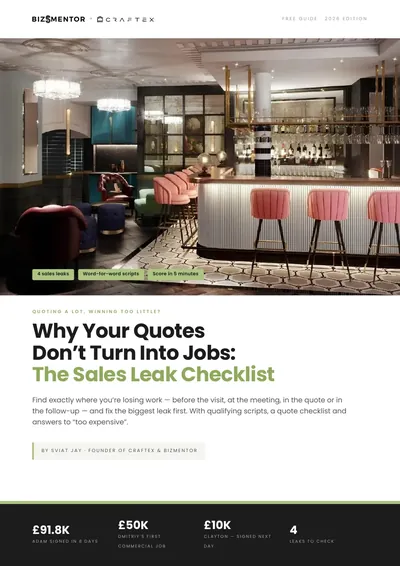
The Sales Leak Checklist
Find your four sales leaks before you hire someone to sell. Scripts and a pipeline tracker included. 14 pages, free.
Get the free guideBefore you hire a salesperson
- Your sales process is written on one page
- You know which of the three roles you need
- Commission is on gross profit, paid on the client's payment
- You have a price floor only you can go below
- Their 90-day plan and weekly numbers are ready