Is a Pay When Paid Clause Illegal in the UK?


The short answer
Not illegal to write, but it doesn't work. Under the Construction Act a pay when paid clause is ineffective in a construction contract, unless the party further up the chain is insolvent. Since October 2011 'pay when certified' is ineffective too. If your subcontract has one, the statutory payment rules apply instead, and you can still apply, suspend and adjudicate.
- Ineffective, not a crime. The clause stays on paper, but the main contractor can't use it to delay or avoid paying you.
- One exception: insolvency. It can only bite if the client further up the chain is formally insolvent, and the wording must cover how.
- Pay when certified is out too. Payment can't depend on another contract or a certifier's decision on it (contracts from 1 October 2011).
- Your fix is the process. Apply on time, watch for notices, then suspend on 7 days' notice or go to adjudication.
Your main contractor says they'll pay you when their client pays them. The money was due two weeks ago. Your subcontract even has a clause that says so. Is that legal?
In short: the clause is on paper, but in UK construction it doesn't work. This guide is for UK subcontractors who are being told "we haven't been paid yet". It shows what the law says, the one exception and what to do this week.
It comes from the owner of a working London construction company that runs main contracts and pays its own subcontractors every month. If you'd rather talk it through, book a free strategy call.
What the law says about pay when paid
The Housing Grants, Construction and Regeneration Act 1996 (the Construction Act) deals with it in section 113. A clause that makes your payment depend on the main contractor being paid by someone else is ineffective. It is not a crime to write one. It simply can't be used against you.
When the clause drops out, the parties can agree other terms. If they haven't, the payment rules of the Scheme for Construction Contracts fill the gap. Either way, you get proper due dates and a final date for payment.
- Pay when paid
- Pay if paid
- Back-to-back payment
- Paid on receipt of client funds
These are all the same thing under a different name. Whatever your subcontract calls it, if payment waits on someone else's money, section 113 applies.
The one exception: insolvency
There is one case where a pay when paid clause can still work. That is when the party who should pay the main contractor is insolvent, as the Act defines it. Think administration, liquidation or a similar formal process.
Even then, courts read these clauses strictly. In William Hare v Shepherd (Court of Appeal, 2010), the subcontract listed only a court-ordered administration. The developer went into administration out of court instead. The main contractor relied on the clause anyway and lost: it had to pay the subcontractor £996,683.35.

Accepting "our client is in trouble" as the same as insolvent. Ask for the name of the company, check Companies House and ask which formal process it is in. Slow payment or a cash problem is not insolvency.
If the client really has gone bust, read what to do when a main contractor goes into administration. The same steps help when it's the employer above them.
Main contractor hiding behind 'we haven't been paid'?
Book a free call with our team. We'll go through your subcontract, your dates and the next step to get your money in.
Pay when certified is out too
Some subcontracts try a different route: you're paid when the architect or QS certifies the main contractor's work under their contract. For contracts made on or after 1 October 2011, that doesn't work either.
The Act now says your payment can't depend on obligations under another contract. Nor can it depend on someone's decision about whether they were met. So these don't hold:
| Clause says | Does it hold? | What applies instead |
|---|---|---|
| Paid when we are paid | No (unless insolvency) | Agreed dates or the Scheme |
| Paid when our work is certified | No (contracts from Oct 2011) | Agreed dates or the Scheme |
| Paid 30 days after your application | Yes, if it gives clear dates | Your contract dates |
| Paid within 90 days of invoice | Usually yes, if dates are clear | Your contract dates |
Long terms are a commercial problem, not a legal one. A 60 or 90-day term can be lawful. Negotiate it before you sign; once it's agreed, the Act won't shorten it.
Being told you'll be paid "when we're paid"?
Book a free strategy call and we'll help you work out what's due and when.
What to do if your main contractor won't pay
Don't argue about the clause. Use the payment process the Act gives you:
- Find your dates: due date and final date for payment, from your subcontract or the Scheme.
- Apply on time: send your payment application with the period, the work done and the sum, and keep proof it was sent.
- Watch for notices: if no valid pay less notice came in time, the sum in your application or payment notice is the amount to pay. See what to do when you receive a pay less notice.
- Chase in writing: one email the day after the final date. Say the clause is ineffective under section 113 and ask for payment by a fixed date.
- Give 7 days' notice to suspend: not paid in full by the final date? You can suspend some or all of your work. Say what, why and from when.
- Refer to adjudication: a decision normally within 28 days. Check what adjudication costs before you start.
The full day-by-day plan is in main contractor not paying a subcontractor.
If you work for a homeowner directly, the Construction Act's payment rules don't cover that contract. But if you're a subcontractor to a builder on a house job, your subcontract is still covered.
Keep it out of your next subcontract
The best time to deal with pay when paid is before you sign. Sviat's view from running Craftex: be firm with clients and fair with subcontractors. On your side of the table, that means:
- Read the payment clause first: due dates, final date, notices. If payment depends on anyone else's money or certificate, mark it.
- Ask for a clean term: "paid X days after our application", with the dates written in.
- Price long terms: 60 or 90 days means you fund the job. If you accept it, the price should say so.
- Check who's above: ask who the employer is and check them on Companies House before a big package.
- Keep one record: applications, notices, emails and dates in one folder per job.
On bigger packages a commercial manager does this for you, from reading the subcontract to the final account. Joe Crawford, Craftex's Commercial Director, has 37+ years in commercial construction. See our construction commercial management service.
Getting paid is a system
Adam and Ali were stuck at about £500K a year with Adam running most of the business himself. After putting structure in place, they won a £528K project in about 4 months.
Individual results, not typical or guaranteed.
Sviat mentors owners one to one himself, while still running his own construction company. He looks at how you price, sign and get paid, then builds the system that fits your business. The aim is results in about 4 months, not the 1–3 years many coaching programs take.
To stop financing your main contractors, book a free strategy call. Or score your business in 4 minutes with the free Construction Business Scorecard. If chasing payment is eating your week, our commercial management service handles applications, pay less notices and final accounts for you.
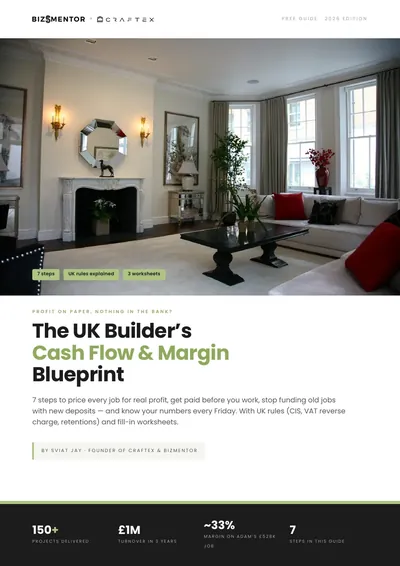
The Cash Flow & Margin Blueprint
Payment terms to ask for, the UK rules that protect your cash, and a fill-in payment schedule.
Get the free guideThis guide is general information, not legal advice. For a large sum or a disputed clause, speak to a construction solicitor.
Before you chase
- You know your due date and final date for payment
- Your application was sent on time and you have proof
- You checked for a valid pay less notice
- You checked whether the client above is formally insolvent
- Your 7-day suspension notice is drafted and ready