Carpentry & Joinery Business Profit Margins: 5 Steps to Keep More

The short answer
Joiners lose money in the workshop hours nobody counts and in timber bought at last month's price. Cost workshop and site time apart and price every job from drawing to finish.
- Workshop hours are labour. In our fitted-wardrobe example, 20 untracked workshop hours mean about £783 of price never charged.
- Price from drawing to finish. Measure, workshop, fit and finish each get hours, costed at your true hourly rate.
- Site reality is billable. Out-of-level walls, design changes after cutting and waiting for other trades are variations.
- Job-cost first and second fix apart. In our example, first fix lost 11 points of margin while second fix gained 3.
A joinery business profit margin in the UK slips away in workshop hours nobody records and timber priced last month. This page shows carpentry and joinery firms how to cost both and price every job. Want your rates checked? Book a free strategy call.
Two businesses under one roof: site and workshop
Most carpentry and joinery firms run two operations at once. Site work — first and second fix, doors, stairs, kitchens fitted on site. Workshop work — wardrobes, fitted furniture and bespoke joinery made before it reaches site.
They cost money in different ways. Site work loses margin to other trades and out-of-level buildings. Workshop work loses it to hours nobody writes down and to timber bought at the wrong price.
Want more of either kind of work from commercial clients? See how to get commercial joinery contracts.
I came to the UK from Ukraine with £6K of debt, started as a labourer, then worked as a carpenter.
As Sviat tells it on our About page, a skilled carpenter was the one who showed him higher standards. The method below is what he uses in his own company and teaches clients.
Cost workshop and site hours separately
Workshop hours are real labour. Track them per job just like site hours — they are often where the money goes.
Give every job two timesheets, one for the workshop and one for site. Then set up your budget in four lines: first and second fix; kitchens, wardrobes and fitted furniture; doors, stairs and windows; and bespoke workshop joinery.
| Cost centre | What it carries |
|---|---|
| Site | Fitting hours, travel, parking, access |
| Workshop | Machining, assembly, finishing hours, rent, power, extraction, machine upkeep |
Workshop rent and running costs are often buried in general overheads. Then your site rate is too high and your workshop rate too low, and you win the wrong jobs. To split the two from your own accounts, book a free strategy call.
Which number is costing you most? Take the free 4-minute Construction Business Scorecard: 18 questions on your pipeline, sales, pricing, cash flow and systems, with your weakest area shown first.
Price fitted furniture from drawing to finish
Worked example: pair of fitted alcove wardrobes (example figures)
| Stage | Hours | £ |
|---|---|---|
| Measure and design | 3 | 82.20 |
| Workshop: cutting and assembly | 20 | 548.00 |
| Fit on site | 12 | 328.80 |
| Finish and snag | 4 | 109.60 |
| Sheet materials and hardware | — | 850.00 |
| Spray finishing (subcontract) | — | 400.00 |
| Direct cost | 39 | 2,318.60 |
| Price at 30% floor (÷ 0.70) | 3,312 |
Leave out the 20 workshop hours — because "that's just making it" — and you quote about £2,529. That's £783 less, on one job.
Hours are costed at £27.40, the true cost of a joiner on £18 an hour after employer NI, pension and holiday.
Pricing fit-out and joinery packages every week and running out of evenings? Compare outsourcing estimating with hiring an estimator, or hand the pricing to our estimating and pre-construction team.
Want your workshop and site rates worked out from your own numbers?
Book a free call.
Protect your margin from timber prices
Timber and sheet materials change price between quote and order. The government publishes monthly building materials price statistics, so check the trend before you price a large job.
- Keep quote validity short and write the date on the quote.
- Add a clause: materials priced at today's cost, may be re-priced if the order is delayed.
- Take a deposit on order and buy the materials with it.
- Update your rates from real invoices, not last year's price list.
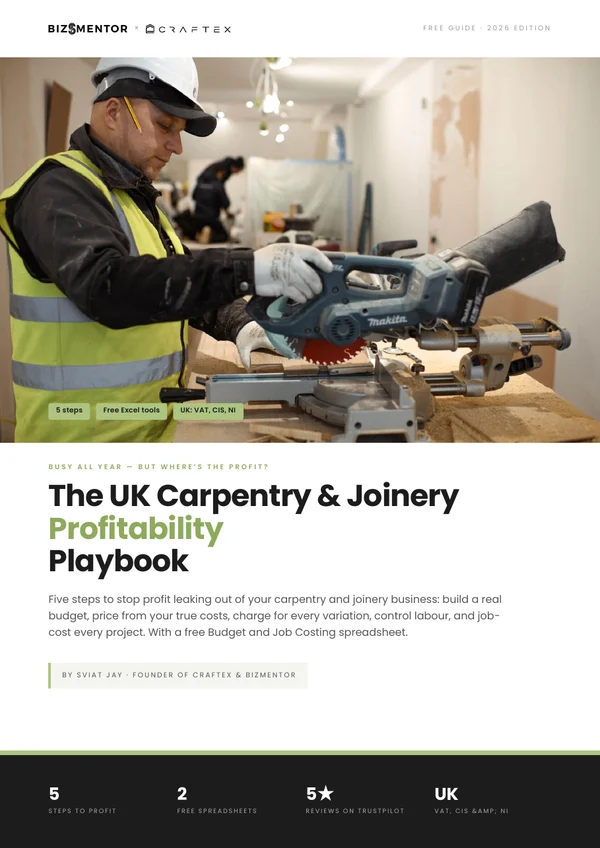
UK Carpentry & Joinery Profitability Playbook
Get the free guideCharge for site reality
The building is rarely as square as the drawing. Typical carpentry and joinery variations:
- the client adds doors, skirting or shelving once you are on site
- walls and floors out of level that need extra packing and scribing
- a design change after you have cut or ordered materials
- waiting for other trades before you can fit
Write the assumption into the quote ("walls plumb and floors level within normal tolerance"). When it's not true, price the extra the same day and get approval in writing.
Agreeing a design change after the carcasses are cut, without a price. The wasted material and the second set of workshop hours are yours.

Price the workshop's compliance and run job costing
A workshop has costs a site van doesn't, and they belong in your workshop hourly rate:
- Dust extraction. HSE sets a legal limit of 3 mg/m³ for hardwood dust (5 mg/m³ for softwood). Carpenters and joiners are four times more likely to develop asthma than other UK workers.
- Inspection. Extraction must be examined by a competent person at least every 14 months.
- Clean-up. Use a Class M vacuum, not a broom or compressed air.
Then compare quoted and actual numbers by job type:
| Job | Type | Price | Quoted GP | Actual GP |
|---|---|---|---|---|
| Example A | First fix | £8,571 | 30% | 19% |
| Example B | Second fix | £2,400 | 35% | 38% |
First fix lost 11 points — often waiting time or unpriced extras. Second fix beat its target.
Chris, a carpenter, went from job to job to £70K+ contracts and £150K projects within six months (see client results). Individual results, not typical or guaranteed.
On contractor work, CIS applies: 20% is deducted from labour if you're registered, 30% if not.
Get the free PDF guide
14 pages. Sent to your inbox in 2 minutes.
Ready to move from job to job to bigger joinery contracts?
Book a free strategy call.
Before you send your next joinery quote
Tax and safety points are general information as of October 2026. Check the details with your accountant and current HSE guidance.
Before you go
- Workshop and site hours are both on the quote
- Every hour is costed at your true rate, not the wage
- Quote has a validity date and a materials clause
- Level and access assumptions are written down
- Last three jobs were job-costed by stage